Cascadia Fault How Will You Know It Is Coming
The Cascadia and San Andreas Faults may be linked, with earthquakes on one triggering events in the other "with minimal or no separation in fourth dimension," scientists have said.
Chris Goldfinger and Joel Gutierrez, from Oregon Land University, say their bear witness showing a human relationship between the two goes dorsum near iii,000 years.
The controversial findings, which take not however been published, will be presented at the American Geophysical Spousal relationship fall meeting in San Francisco on Friday.
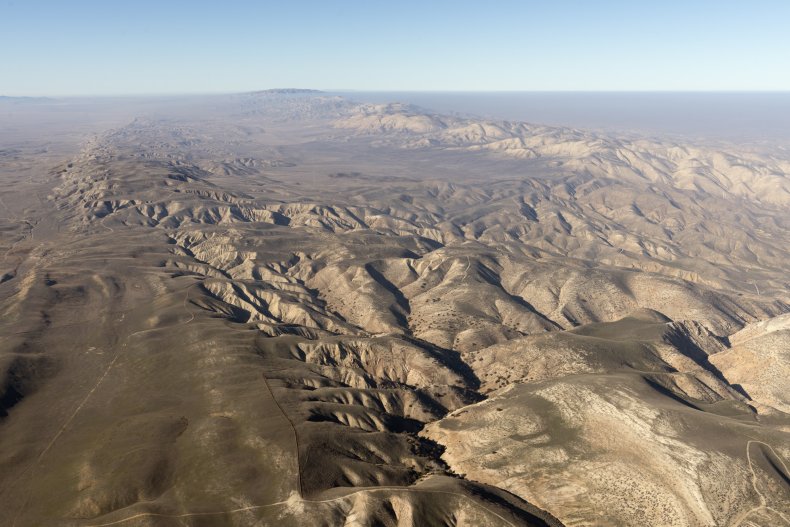
The San Andreas Fault forms part of the tectonic boundary between the Pacific and Northward American Plate. It stretches about 750 miles along the east coast and has the potential to produce major earthquakes.
It is one of the nearly dangerous faults in the U.South. as it is lined past heavily populated areas, including the cities of Los Angeles, San Francisco and San Diego.
Considering there has non been a large earthquake at San Andreas for over 100 years, experts are concerned it could be due one relatively soon.
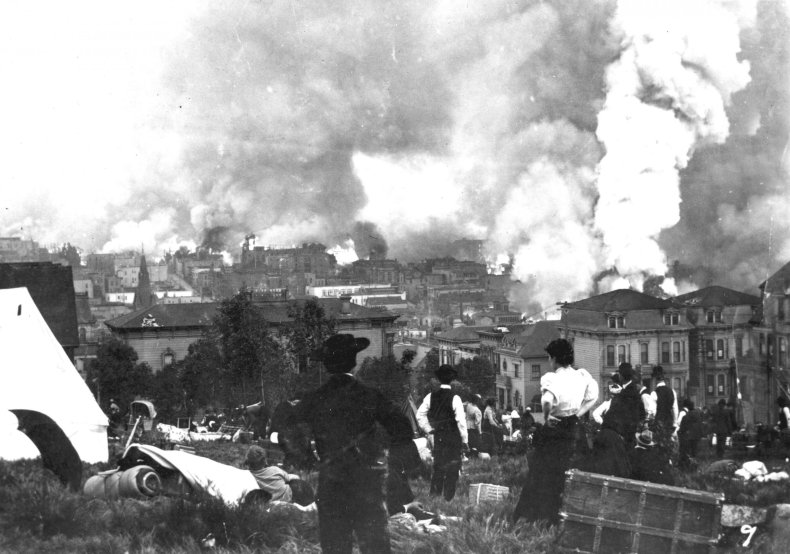
Meanwhile, the Cascadia Subduction Zone, which stretches from northern California to Canada, is known equally a "megathrust" fault that can produce some of the biggest earthquakes in the earth. In 1700 information technology produced an earthquake estimated to be between magnitude 8.7 and 9.2. According to the Canadian government, in that location have been xiii megathrust earthquakes at the subduction zone in the last 6,000 years. "Some accept been as close together as 200 years and some have been every bit far apart equally 800 years. The terminal 1 was 300 years agone," it said.
In their research, Goldfinger and Gutierrez looked at the 2 next faults and their histories by using stratigraphic evidence—looking at layers of rocks. From this, they were able to look back at when earthquakes took place at each fault over 2,800 years. Their findings show that on multiple occasions, an earthquake at Cascadia would be followed by 1 at the northern office of the San Andreas Fault. "In one case, a separation of [about] 100 years is observed, simply in all other cases, time separation between the pairs is not observed," the research abstract said.
Goldfinger and Gutierrez say their research suggests earthquakes at Cascadia can trigger earthquakes at the northern end of San Andreas. According to Nature magazine, the researchers found that this happened at least eight times over two,800 years. "This is generally a circumstantial case," Goldfinger told the magazine. "I don't have a smoking gun."
The idea the two tectonic zones are linked was start proposed by Goldfinger over 10 years ago. However, at the fourth dimension the team did not have plenty geological evidence to dorsum it up. By looking at the stratigraphic information, they were able to show concurrent events.
In an electronic mail to Newsweek, Goldfinger said: "This testify has forced u.s. to conclude, equally we did earlier, that these two bully faults are interacting, one triggering the other, infinite closely in time. The prove conspicuously points to Cascadia first, and then some short time later, the San Andreas goes. The evidence was not and so stiff when we had only radiocarbon, but at present we are seeing the stacked beds together, and it's much stronger. Similar most things in geology though, you never go to see the event, so in that location are ever uncertainties.
"At this point, alternative explanations are few and crave some tortured coincidences, a conclusion we've reached after nearly 20 years working on the problem."
Not everyone is convinced. Joan Gomberg, a seismologist at the U.S. Geological Survey, told Nature that the information could be interpreted differently, with a far less "sensational" determination. Gomberg says the layers existence analyzed exercise not show exactly when or where earthquakes took place. "All this uncertainty leaves multiple, equally plausible interpretations on the table," the seismologist said.
John Vidale, a seismologist from the University of Southern California, told Northwest News Network that many of the details of the research are "still hazy." However, he added: "It's not so common to have linkage across 2 different kinds of faults, from a subduction zone onto a strike-slip fault. So this would exist kind of new and interesting."
Goldfinger told Nature that he was putting the case out in that location for the two zones being continued. Speaking to Northwest News Network, he said: "When you accept ii large faults that connect directly, there's a pretty loftier probability they're going to interact in some style. So one fault triggering some other, or fifty-fifty becoming synchronized with the other for a period of time, is not a fantastical scenario. It is really a fairly likely scenario. Information technology just isn't on the radar anywhere nonetheless."
He told Newsweek that their findings could have implications for earthquake forecasting. If an convulsion were to hit Cascadia, it is possible San Andreas may experience 1 soon after—from just hours to several decades.
"Information technology means that the almost incalculable impairment that will take place from the adjacent convulsion on either mistake, could include both," he said. "Assessments that never include both faults at one time, should brainstorm to consider that every bit a possible scenario, and non a black swan scenario, merely a probable i."
This article has been updated with additional comments from Chris Goldfinger.
Source: https://www.newsweek.com/san-andreas-cascadia-faults-linked-1476450

Enregistrer un commentaire for "Cascadia Fault How Will You Know It Is Coming"